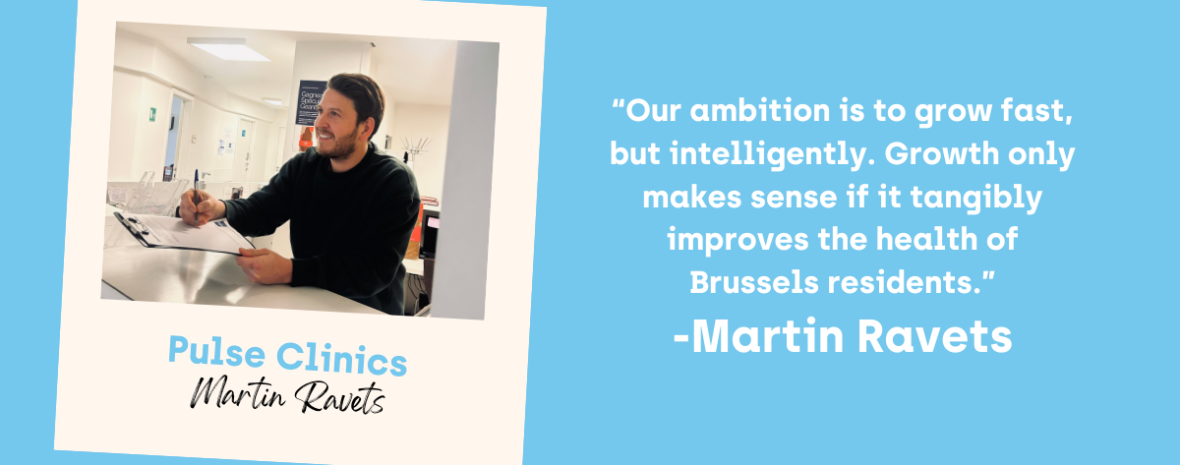
Placing Brussels patients at the heart of medical care to make visits to local healthcare centres more welcoming and prevention unavoidable — this is the ambition of Pulse Clinics, founded by Martin Ravets.
An ambitious project, firmly rooted in both the founder’s family and professional background, as well as in his personal experience as a Brussels-based entrepreneur.
Indeed, supporting healthcare professionals has been a family tradition for the Ravets since the creation in 1947 of CMD (Centrale Médico-Dentaire), a dental sector agent representing manufacturers exclusively for the Benelux market. After cosmopolitan business studies and early professional experiences in Shanghai and Belgium, Martin Ravets became the third generation to lead CMD, until the shock of the Covid crisis.
A critical perspective
This did not dampen the entrepreneur’s determination. On the contrary, it reinforced his desire to identify and solve concrete problems — naturally within the healthcare sector.
“On a personal level, I had experienced how fragmented care can be, how limited collaboration between doctors often is, and how cold and anxiety-inducing patient reception areas tend to be. Most medical centres and polyclinics were created by doctors to share costs and remain a juxtaposition of independent practices. In Brussels today, doctors do an excellent job, but the sector faces real tensions and, above all, a lack of care organisation. The entire framework could be rethought,” he explains.
“As early as 2022, the idea emerged to develop a new multidisciplinary healthcare centre concept — Pulse Clinics — where patient experience would be prioritised, where synergies within the medical team would be actively encouraged to avoid siloed work and foster collaboration. And where the specific characteristics of Brussels would be fully taken into account: cultural diversity, social vulnerability, mobility challenges, and more.”
A strategic takeover
In 2024, a unique opportunity arose: three polyclinics — two in Schaerbeek and one in Koekelberg — were facing closure. Martin Ravets did not hesitate. He took over and saved the three sites, which officially became the first Pulse Clinics on 12 November 2024.
The new concept was integrated into CMD Group, now structured around three pillars:
- AxeMed, which took over the activities of the historic family industrial company and manages imports, logistics and regulatory compliance;
- Promodent, responsible for distribution to medical and dental practices;
- Pulse Clinics, the new pillar dedicated to local outpatient care.
“Our ambition is to build a vertically integrated outpatient care platform designed to support the structural transition from a hospital-centred model to proximity-based, prevention-focused care. Concretely, patient needs are fed back to manufacturers, and conversely, the clinical impact of products and services is measured in real-life care settings,” he explains.
Reflection and transformation
The year 2025 was dedicated to an in-depth phase of analysis, reflection and behind-the-scenes transformation.
“We first had to understand from the inside how these existing structures actually functioned,” says Martin Ravets. “Before implementing our vision of neighbourhood care, processes and patient journeys, we had to make extensive changes — overhaul IT systems, invest in equipment, and immerse ourselves in the complex realities of Brussels. It was a substantial undertaking.”
A clear objective
Following this initial phase, major renovation works are planned during the first half of 2026 across the three Pulse Clinics, so that both patients and healthcare teams can fully benefit from the envisioned model.
One key objective remains central: encouraging prevention.
“Prevention must primarily come from patients themselves — people who proactively take care of their health by scheduling check-ups in advance and adopting healthier lifestyles. They must become the driving force of prevention in Brussels. To achieve this, we need to offer a welcoming care environment that positively influences their mindset from the moment they arrive.”
Looking ahead
Physical transformations are being implemented step by step, both in examination rooms and reception areas, and Martin Ravets welcomes the progress.
“To my knowledge, very few primary care centres place patient experience at the core of their model,” he notes. “Through events organised by the lifetech.brussels that I attended last year, I saw remarkable work being done in research and scientific innovation. Pulse Clinics aims to be complementary, by focusing on real-world operational challenges and everyday patient experience.”
Still, he remains cautious.
“Our goal is, of course, to grow — because growth means having a greater positive impact on people’s health. But speed is not the objective. Growth only makes sense if it does not compromise patient experience or medical practice. The first three Pulse Clinics must prove themselves: be efficient, financially sustainable and welcoming. Only once the model has demonstrated its reliability will further development be considered.”
He concludes modestly:
“We do not claim to be the solution, but a solution. We want to show that it is possible to do better — and to do things differently.”
Pulse Clinics: putting patient experience and prevention first
Placing Brussels patients at the heart of medical care to make visits to local healthcare centres more welcoming and prevention unavoidable — this is the ambition of Pulse Clinics, founded by Martin Ravets.
An ambitious project, firmly rooted in both the founder’s family and professional background, as well as in his personal experience as a Brussels-based entrepreneur.
Indeed, supporting healthcare professionals has been a family tradition for the Ravets since the creation in 1947 of CMD (Centrale Médico-Dentaire), a dental sector agent representing manufacturers exclusively for the Benelux market. After cosmopolitan business studies and early professional experiences in Shanghai and Belgium, Martin Ravets became the third generation to lead CMD, until the shock of the Covid crisis.
A critical perspective
This did not dampen the entrepreneur’s determination. On the contrary, it reinforced his desire to identify and solve concrete problems — naturally within the healthcare sector.
“On a personal level, I had experienced how fragmented care can be, how limited collaboration between doctors often is, and how cold and anxiety-inducing patient reception areas tend to be. Most medical centres and polyclinics were created by doctors to share costs and remain a juxtaposition of independent practices. In Brussels today, doctors do an excellent job, but the sector faces real tensions and, above all, a lack of care organisation. The entire framework could be rethought,” he explains.
“As early as 2022, the idea emerged to develop a new multidisciplinary healthcare centre concept — Pulse Clinics — where patient experience would be prioritised, where synergies within the medical team would be actively encouraged to avoid siloed work and foster collaboration. And where the specific characteristics of Brussels would be fully taken into account: cultural diversity, social vulnerability, mobility challenges, and more.”
A strategic takeover
In 2024, a unique opportunity arose: three polyclinics — two in Schaerbeek and one in Koekelberg — were facing closure. Martin Ravets did not hesitate. He took over and saved the three sites, which officially became the first Pulse Clinics on 12 November 2024.
The new concept was integrated into CMD Group, now structured around three pillars:
- AxeMed, which took over the activities of the historic family industrial company and manages imports, logistics and regulatory compliance;
- Promodent, responsible for distribution to medical and dental practices;
- Pulse Clinics, the new pillar dedicated to local outpatient care.
“Our ambition is to build a vertically integrated outpatient care platform designed to support the structural transition from a hospital-centred model to proximity-based, prevention-focused care. Concretely, patient needs are fed back to manufacturers, and conversely, the clinical impact of products and services is measured in real-life care settings,” he explains.
Reflection and transformation
The year 2025 was dedicated to an in-depth phase of analysis, reflection and behind-the-scenes transformation.
“We first had to understand from the inside how these existing structures actually functioned,” says Martin Ravets. “Before implementing our vision of neighbourhood care, processes and patient journeys, we had to make extensive changes — overhaul IT systems, invest in equipment, and immerse ourselves in the complex realities of Brussels. It was a substantial undertaking.”
A clear objective
Following this initial phase, major renovation works are planned during the first half of 2026 across the three Pulse Clinics, so that both patients and healthcare teams can fully benefit from the envisioned model.
One key objective remains central: encouraging prevention.
“Prevention must primarily come from patients themselves — people who proactively take care of their health by scheduling check-ups in advance and adopting healthier lifestyles. They must become the driving force of prevention in Brussels. To achieve this, we need to offer a welcoming care environment that positively influences their mindset from the moment they arrive.”
Looking ahead
Physical transformations are being implemented step by step, both in examination rooms and reception areas, and Martin Ravets welcomes the progress.
“To my knowledge, very few primary care centres place patient experience at the core of their model,” he notes. “Through events organised by the lifetech.brussels that I attended last year, I saw remarkable work being done in research and scientific innovation. Pulse Clinics aims to be complementary, by focusing on real-world operational challenges and everyday patient experience.”
Still, he remains cautious.
“Our goal is, of course, to grow — because growth means having a greater positive impact on people’s health. But speed is not the objective. Growth only makes sense if it does not compromise patient experience or medical practice. The first three Pulse Clinics must prove themselves: be efficient, financially sustainable and welcoming. Only once the model has demonstrated its reliability will further development be considered.”
He concludes modestly:
“We do not claim to be the solution, but a solution. We want to show that it is possible to do better — and to do things differently.”
Website: https://pulseclinics.be/